Bader Al Abri
October 17 marks the International Day for the Eradication of Poverty. Throughout history, one of the most significant institutions associated with human societies in their efforts to alleviate poverty has been waqf (endowment). Waqf essentially means preserving an asset while dedicating its benefits to others, thereby transferring its utility from private ownership to a broader sphere of public benefit.
The question of combating poverty has moved beyond the concept of charity toward the recognition of rights and the realization of human dignity within the framework of equality and social justice. Similarly, the question of waqf has evolved beyond the traditional notion of ongoing charity (sadaqah jariyah) toward empowerment and the realization of human dignity. Today, waqf should no longer be viewed merely as a form of ongoing charitable giving, but rather as an essential social and humanitarian necessity.
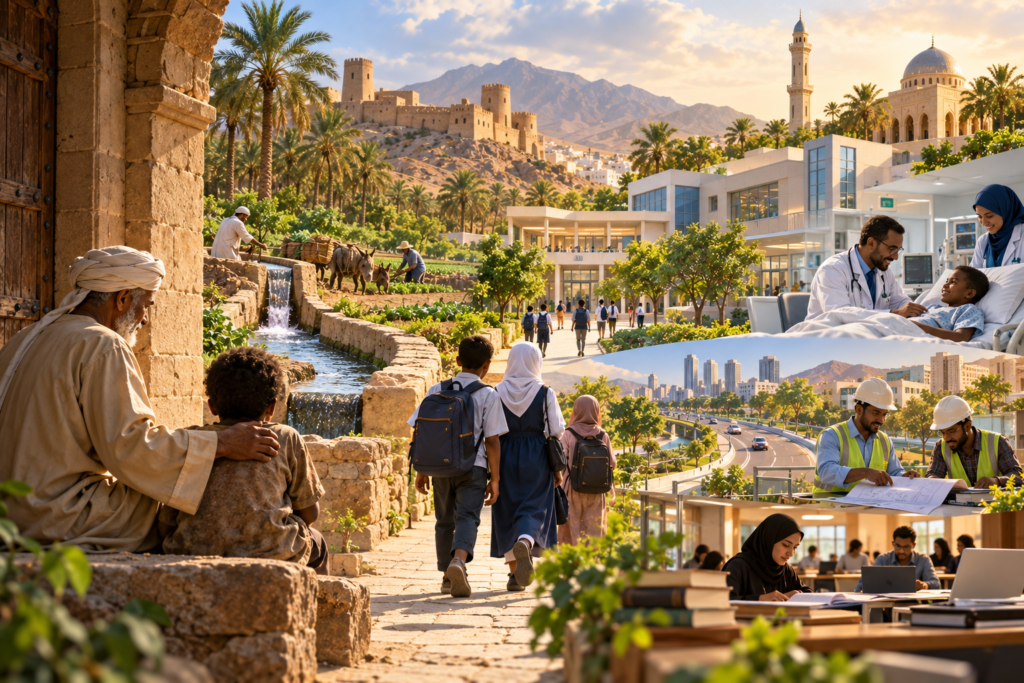
Throughout human history, among different nations and civilizations, endowments have been associated with humanitarian purposes, including those related to animals, fortresses, water resources, traditional irrigation systems (aflaj), schools, and other institutions. Ultimately, however, their purpose has been to serve human beings. Endowments dedicated to donkeys and other working animals, for example, helped people travel and transport their belongings. Endowments for fortresses supported soldiers who protected people, maintained security, administered public affairs, and upheld justice. Endowments for water resources and irrigation systems provided drinking water for people and their animals, as well as irrigation for their crops. Educational endowments supported learning and intellectual awareness. In all these cases, the ultimate beneficiary was the human being.
Today, the modern nation-state is complex and diverse. Not all countries share the same geographical, economic, or social circumstances. Some are landlocked within terrestrial borders, while others have access to vast maritime spaces. Some possess abundant mineral resources, others are rich in agricultural resources, and still others enjoy diverse tourism potential. Certain countries are characterized by considerable religious, ethnic, and sectarian diversity. These differences influence their material, economic, social, and cultural conditions, producing significant disparities among nations.
Because of the complex economic and material circumstances facing countries today, and the historical conflict between capitalism and socialism, whose consequences remain evident, new theories have emerged in an attempt to reconcile the two systems on the one hand, and to protect human beings from the excesses of capitalism and the overreach of socialism on the other.
Among these is Anthony Giddens’s Third Way, which seeks to find a middle ground between the two approaches. Another example is Kate Raworth’s Doughnut Economics, which may be understood as contributing to the humanization of wealth and financial resources, so to speak. Other approaches include theories of the solidarity economy.
Similarly, Islamic thinkers, working within the framework of the Islamization of knowledge and economic thought, have attempted to develop an interpretive theory that combines private ownership with public benefit. Such approaches intersect with other theories that seek to restrain the excesses of capitalism, including the Third Way. At the same time, theories have emerged that may be regarded as even more extreme in their commitment to market freedom than conventional capitalism, such as libertarianism, which I previously discussed in an article entitled “The New American Oligarchy.”
In its broad social meaning, waqf is closer to socialism in its attempt to limit the dominance of capitalism. However, today it is also closely connected to the question of humanizing endowments. This does not mean that waqf was historically disconnected from human concerns. Rather, over time, the concept of ongoing charity came to overshadow the social and humanitarian necessities that endowments were originally intended to address.
In some impoverished countries, for example, we find hundreds of endowments dedicated to enormous places of worship adorned with elaborate gilding and decorative inscriptions. Yet only a short distance away, there may be dozens of informal settlements inhabited by homeless and deprived people. Some of these very individuals may even contribute portions of their limited resources to such religious buildings and their endowments, hoping thereby to attain a better life than the one they currently endure.
The concept of ongoing charity has thus shifted from a concern with human existence toward a closed form of otherworldly preoccupation. Some have come to imagine that the highest expression of ongoing charity lies in constructing magnificent places of worship rather than investing in human development.
Consequently, when the subject of ongoing charitable endowments is raised, their minds do not immediately turn to universities, hospitals, schools, roads, businesses, public parks, or cultural centers. Instead, they tend to think of places of worship whose construction involves excessive expenditure and unnecessary extravagance, although God has not commanded such extravagance.
Moreover, substantial funds may accumulate within these religious endowments, while their expenditure on other humanitarian needs, which society may urgently require, is prohibited. As a result, only a limited group may benefit from these resources. Some funds may be spent on teaching otherworldly doctrines and engaging in closed theological disputes, while societies desperately need to develop human capabilities in industry, innovation, the arts, and other fields essential to human progress and development.
This reminds me of ongoing charitable endowments directed toward the Dark Continent (Africa). Considerable sums of money are spent on religious and sectarian proselytization, the construction of places of worship, and religious schools affiliated with them. Such activities are often accompanied by narrow religious and sectarian controversies.
Meanwhile, comparatively little attention is devoted to empowering African people themselves or revitalizing their societies through schools and universities capable of producing doctors, engineers, philosophers, legal professionals, and others who can contribute to building their countries and advancing them through development, progress, and knowledge.
The question of waqf also invites us to move beyond charity understood merely as benevolence toward charity understood as empowerment.
There is a subtle but fundamental difference between helping a poor person by occasionally giving them money as temporary assistance and empowering that person to become economically productive and capable of securing their own livelihood.
Such empowerment may involve providing education and vocational training that enables individuals to master a profession, or offering them a shop or the necessary tools and resources to earn a living, repay their debts, secure housing, and establish a sustainable income through their own efforts.
This approach preserves human dignity and enables individuals to contribute actively to society through their abilities, skills, and professions.
Likewise, there is a significant difference between assisting a sick person by providing money for medical treatment at home or abroad and contributing, through waqf itself, to the long-term development and empowerment of hospitals.
Such endowments could help provide the most advanced medical equipment, support the training of new generations of highly qualified physicians across various medical specialties, contribute to pharmaceutical development, and strengthen medical research centers.
Charity understood as temporary financial assistance is inherently limited. By contrast, charity understood as sustainable empowerment represents the true meaning of humanizing waqf and enhancing its capacity to serve society.
There are many other dimensions to the humanization of waqf, all of which can contribute to strengthening equality and justice within society. They can also help societies advance toward a more comprehensive humanization of cities, roads, public parks, mental health facilities, industry, innovation, and every field that contributes to human development and empowerment.
Ultimately, the humanization of waqf means placing the human being at the center of its purpose, transforming endowments from instruments of limited charitable assistance into sustainable institutions that promote human dignity, social justice, and the empowerment of individuals and communities.
Translated by Artificial Intelligence (AI)