Badar Al Abri
Oman Newspaper, Wednesday, 30 Jumada al-Ula 1448 AH / 4 November 2026 CE
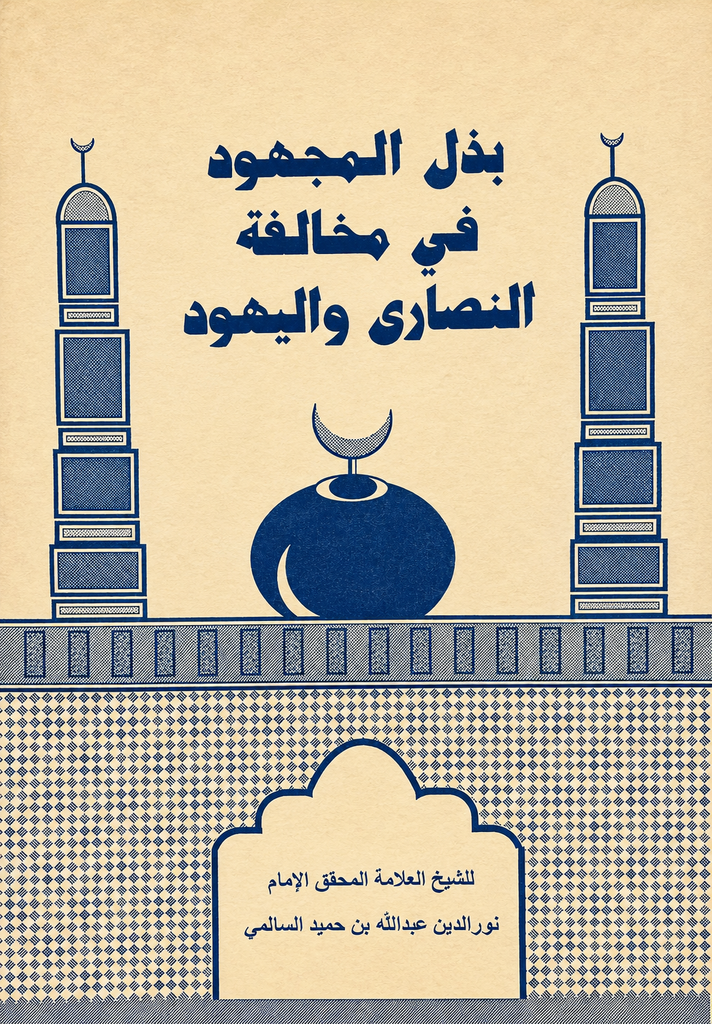
I watched an episode on “Awalim,” an Omani media platform, about Exerting Every Effort to Differ from Christians and Jews, a book by Nur al-Din Abdullah bin Humayd al-Salimi (d. 1332 AH/1914 CE). Originally a treatise, it was written in response to objections raised against an answer he had given to Omanis in Zanzibar, apparently by an Omani jurist living there. The treatise dates to Muharram 1328 AH/February 1910 CE—more than a century ago, four years before al-Salimi’s death and approximately three years before the establishment of Oman’s last imamate. His grandson, Saud bin Hamad al-Salimi, published the eighty-page treatise in Sha‘ban 1415 AH/January 1995 CE through the Imam Nur al-Din al-Salimi Library in Bidiyah, in North Al Sharqiyah Governorate.
What struck me about the episode was the oversimplification of such interpretations and writings when presenting them to the public, and the continued reliance on conventional binary oppositions inherited from a period of geographical isolation, when contact between communities was relatively limited. Today, by contrast, the world is marked by cultural interconnection, as advances in transport, easier travel, and expanding tourism have increased human interaction, alongside the digital revolution. No direct comparison can therefore be made with the period and circumstances in which al-Salimi lived. He resided in Oman’s interior, largely cut off from the wider world, where people still relied on donkeys and mules and lacked newspapers or access to information about global developments. Meanwhile, the wider world was experiencing industrial modernity. In one of his answers, al-Salimi himself could not envisage the “saykal”—the bicycle—about which he had been asked, even as trains, aircraft, and various forms of bus transport were already advancing elsewhere.
Reintroducing such books as evidence of Omani efforts to resist Westernization or Western colonialism—whether cultural, political, or economic—has a negative effect on the collective mindset when accompanied by claims that their severity was merely a response to particular circumstances, while their prescriptions for differing from Jews and Christians, or polytheists generally, remain applicable today. This effect is compounded by generalized rhetoric that cultivates a sense of separateness from others without engaging contemporary intellectual tools. Contemporary interpretations—even within Islamic thought—have moved far beyond such approaches.
In the Arab world, the treatise belongs chronologically to the Age of Awakening, extending from the second half of the nineteenth century into the early twentieth century. In Oman, however, we are dealing with two entirely different realities: that of Omanis in East Africa and that of Omanis in the Arabian homeland. I discussed this comparison in my article “From Rifa‘a al-Tahtawi to Oman,” published in the cultural supplement of Oman newspaper.
During this period, calls for reform drew upon a spirit initially championed by Hasan al-Attar (d. 1835), who declared: “Conditions in our country must change, and new sciences and forms of knowledge must be introduced.” These calls included educational reform and openness to contemporary sciences and languages. This was also the direction advocated by Jamal al-Din al-Afghani (d. 1897), Abd al-Rahman al-Kawakibi (d. 1902), Muhammad Abduh (d. 1905), and their students. They faced attacks from traditionalists who accused them of promoting “Westernization.” Among these critics was Yusuf bin Isma‘il al-Nabhani (d. 1932), author of Guidance for the Perplexed: Warning Muslims against Christian Schools, a work upon which al-Salimi would rely in his answer and subsequent treatise.
In the East African Omani context, the treatise dates to the reign of Sayyid Ali bin Hamud al-Busaidi (d. 1918), one of the sultans of Zanzibar. His reign continued a phase of modernization that had begun under Sultan Barghash bin Said (d. 1888), who established the Sultan’s Printing Press in Zanzibar in 1879. It also continued the modernization expanded by his father, Sayyid Hamud bin Muhammad al-Busaidi (d. 1902). This was one of the golden periods of Omani modernization in Zanzibar during the Age of Awakening, witnessing the emergence of newspapers, cultural relations with the wider world, and cultural clubs.
In the Omani Arabian homeland, modernization was almost nonexistent at the time, particularly in the interior, the eastern regions, and the inland heartland. Most Omanis had little awareness of the modernization taking place elsewhere, let alone the modernity arising from it. It is therefore understandable that the jurists of that period lacked a clear conception of modernization, much less an understanding of its practical manifestations and concrete examples. Their statements and opinions should be read within this context.
For example, when Sulayman al-Baruni Pasha (d. 1940) sought to establish the Baruni School in Samail and introduce financial reforms in the administration of public funds—as Abu Ishaq Atfayyish (d. 1965) recounts in his book on al-Baruni—some jurists and sheikhs objected:
“This is an innovation, and every innovation is misguidance.” Others said: “This is something Christians do; we will not accept it.” Still others argued: “We did not find our fathers and forebears doing this, and they knew better than we do what was best for the country.”
When Oman began its modernization in 1970, debate arose over numerous issues: contact and social interaction with non-Muslims, the ritual purity of their bodily moisture, bringing them into the country for work and tourism, women’s issues and their entry into the workforce, law and the organization of the state, banks and insurance companies, music, women’s appearances in the media, theatre, sports clubs, and other matters. Anyone examining the record preserved in Omani newspapers and magazines from, for example, 1970 to 1990 will find extensive debate over many aspects of modernization. Yet lived reality proved far more powerful: practices once condemned and regarded with disapproval eventually became familiar and acceptable to those who had opposed them.
I do not intend in this article to revisit or reinterpret al-Salimi’s treatise. It is no different from many fatwas now regarded as objectionable, whether in Oman or across the Islamic world. It should be studied as a historical text whose relevance is bounded by its particular time and place. In my view, the problem lies in the epistemological framework through which we approach this historically contingent heritage and project it onto the collective mindset. This begins with an implicit association with sacredness, followed by treating it as equivalent to the absolute. Absolute judgments are then derived from it, negatively shaping our responses to issues we encounter in everyday life.
Placing followers of other faiths within a closed binary framework, for example, prevents coexistence grounded in our shared humanity—the basis upon which citizenship, theories of large and diverse states, and their external relations can be developed. This is especially pressing now that the world has become an interconnected village. We therefore need to reconsider many of the epistemological frameworks through which we read the history of human social life, including those through which we approach our Omani heritage.
Note: This translation was produced using artificial intelligence (AI).