



Bader Al Abri
Europe, as a whole, managed after the Second World War to impose long-lasting stability on its surroundings—not because politicians willed it, but because intellectuals imposed their voice. Their opinion separated itself from the (childish) behavior of some politicians who ignite wars and invade societies. A clear cultural stance emerged, one that influenced the collective mind, which in turn affected decision-makers. The experience of Hitler still remains present in the European collective memory in general, and the German one in particular.
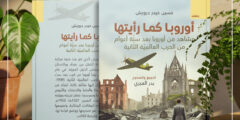
For example, on 14 September 1952, the Omani writer Hussein Haidar Darwish (d. 1999) published an article in the Iraqi newspaper Al-Ahali entitled “The Political Situation in Western Europe.” In it he wrote:
“The European peoples have tasted much of the bitterness of war. The ghosts of past wars are still before their eyes, lodged in their minds. They hate nothing as much as they hate war, and their constant aim is to avoid it at any cost. Most layers of the people favor neither of the two camps; they call instead for neutrality and for staying away from belonging to any international bloc that calls for the ignition of wars.”
Such an attitude is impossible if intellectuals in particular, and society in general, isolate themselves from the political sphere; otherwise the same disaster will repeat itself. For this reason, these peoples worked to entrench freedom of opinion and participation in political decision-making:
“European peoples have been raised on the love of freedom of expression. They voice and express their opinions even when they contradict their governments’ policies or the treaties their governments conclude. A visitor to European countries can observe the views and orientations of their peoples by mixing with them and speaking to individuals of all professions and social classes.”
What is especially striking is how the writer concluded his article:
“Many people in those countries told me frankly that the United States, after beginning to doubt its ability to achieve its aims in Western Europe, has now turned toward the Middle East, believing that the peoples of those regions—especially the Arab peoples—are still in a deep slumber and can easily be persuaded, or rather deceived, into turning their lands into the battlefield of the coming war, bringing upon themselves death and destruction so as to spare American lands from such catastrophes and calamities. It is for the Arab peoples alone to decide their destiny at this critical moment: either to save themselves from this terrifying specter that is beginning to approach them, or to submit to the American will and prepare for blazing bombs, raging fire, ruin and devastation, and all the calamities and disasters that war drags behind it.”
Now, seventy-three years after the publication of this article, has “Has reality proven the truth of the article?” Although Arab states in appearance have become independent from colonialism, in reality we are destroying our own present with our own hands. No sooner does one Arab country settle than war erupts in another—either from within or from among the sons of its own Arabness—until our Arab world has become one of the worst in today’s world: a battlefield in which chaos is unleashed and modern weapons are tested on its lands. The question is: where is the Arab intellectual today?
If we excuse the Arab League for the weakness of its political unity—since no unifying framework remains among its members—Arab nationalism once served as a unifying slogan, at least as a powerful moral drive. But this drive was attacked by what is called the “Islamic Awakening,” which plunged Arab reality into theological conflicts, as if we were in the Abbasid era rather than the modern age. Some even regarded the call for Arab nationalism as unbelief, heresy, and the revival of a new religion. Hope then rested on the Arab writers’ unions and associations—independent public bodies once united under a single federation. Yet this federation was no better than the Arab League, because some of its platforms became politicized and turned into a mouthpiece of power rather than of civil society. It itself split into two camps, especially because of the Yemen war, and since 2022 it has virtually ceased to exist.
In our Arab reality today there are, broadly speaking, two cultural lines. One is that of cultural institutions which, on the surface, serve knowledge, but in essence politicize whoever finances them, justifying what he does today and supporting what he does tomorrow. The other is that of the independent individual intellectuals, who fall into three groups. One group justifies the mistakes of their governments because they belong to them, benefit from their spoils, or are threatened by their security agencies. These live in contradiction between the universal, renaissance-oriented principles of culture and their justifications for the recklessness of politicians; they often undo by day what they wrote by night, because their compass is the movement of the politician rather than fixed human principles and values. A second group has chosen silence and withdrawal, working on itself away from the noise so as not to stain its pen or have its thought and tongue exploited. A third group speaks in the name of universal human values, not beholden to the policies of its own country or any other: if rulers do good, it supports them; if they do wrong, it observes and criticizes them. This last group is the smallest.
What is happening in our present Arab reality requires pens that believe in the Arab human being as an independent individual, possessing inherent human dignity in the pursuit of equality and justice. It requires expanding the space of freedom of opinion, confronting despotism, and resisting the silencing of voices, the buying of pens, and their steering to serve the aims of politicians rather than the higher values of humanity. The intellectual must also participate in political life—meaning to have an active role grounded in human dignity, not in the militarization of politics, its religious ideologization, the gratification of some people’s delusions of expansion, the plundering of other peoples’ wealth, or the building of a hollow grandeur at the cost of the destruction of peaceful nations. If the intellectual abandons this true role, others will fill the arena and lead it toward destruction, as we see in our reality today.