




Bader Al Abri
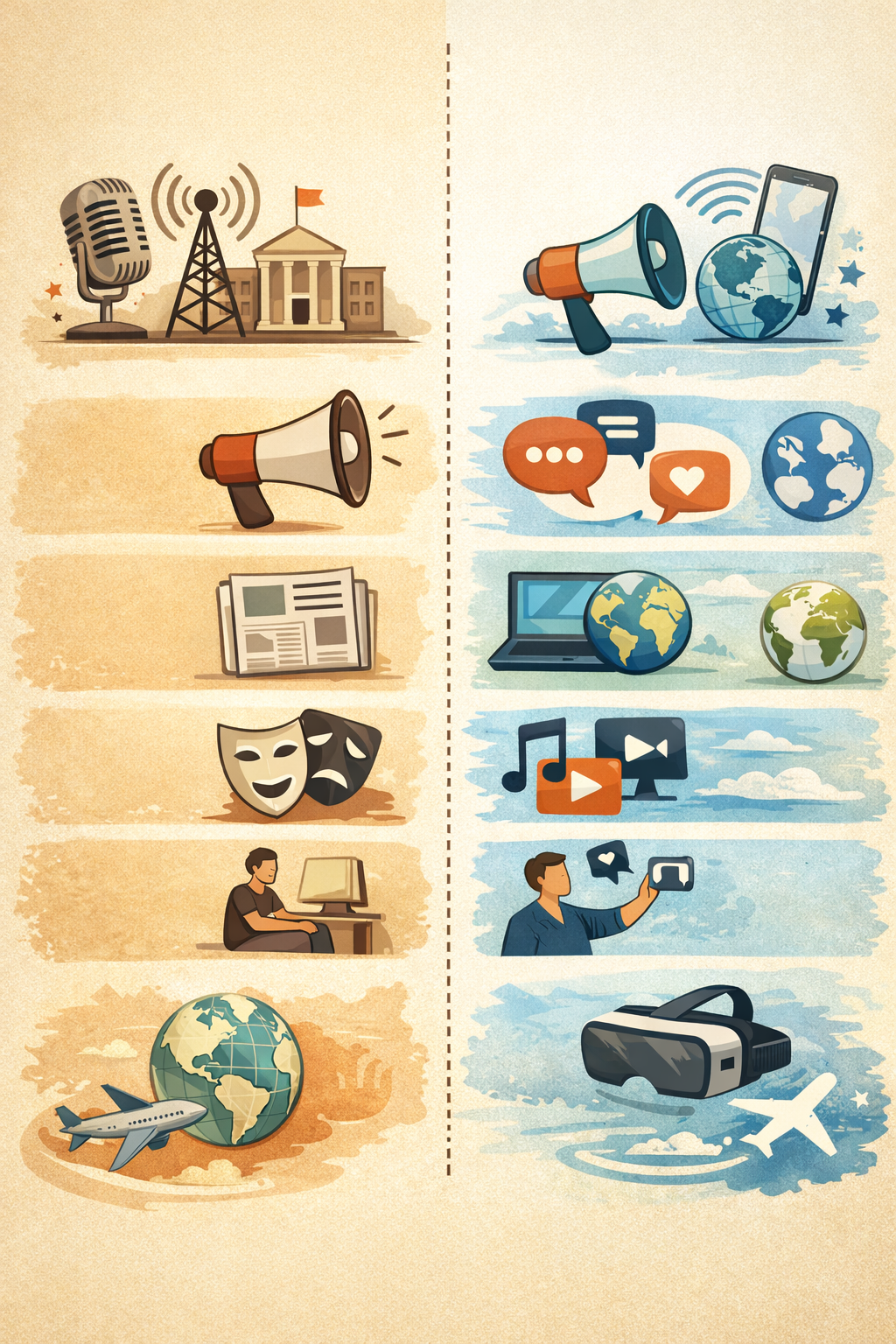
Media, as a means of communication, began with the formation of human gatherings. It is intrinsically linked to humans, and its methods evolved from oral communication to poetry and writing. A major transformation occurred with the invention of printing in the mid-15th century. By the early 17th century, journalism appeared in Germany, and by the end of the 17th century, magazines emerged in France. Newspapers and magazines hosted writers with right- and left-leaning perspectives, which influenced the course of the world with the emergence of the Age of Enlightenment following the Renaissance, bringing writers closer together. In the second half of the 19th century, the radio was discovered, and simultaneously, the television emerged, marking a qualitative shift in audio-visual media.
All of this brought transformations in human social activity, accompanied by the development of stages of enlightenment within societies. However, the second half of the 20th century, the early third millennium, and continuing to the present day, witnessed the greatest transformation in human social life. Media in this phase became linked with the evolution of globalization, a term that reemerged strongly in the 1990s. Some researchers argue that globalization, in its evolutionary sense, began at the dawn of the Enlightenment and appeared during the Industrial Revolution. Yet, in the context of our current media transformation, globalization is associated more with individualization.
If globalization represents a constellation of the world in its political, cultural, economic, and geographic diversity (a single village), it nevertheless remained within collective circles influenced primarily by political or economic reasons. These influences manifested through broader dominance, national or regional dominance, or even narrow institutional dominance. All of these imposed a certain cultural vision based on ideological foundations, political perspectives shaped by reality, or economic objectives in the public market. There were conflicting lines, yet generally clear from a media perspective, though they did not provide a complete or true representation of human societies. Some aspects remained hidden in media for various reasons and purposes, and therefore, many social phenomena were either not represented or not allowed to appear at all.
These diverse and sometimes contradictory social phenomena became more visible with new media, as it liberated itself from traditional or institutional forms of dominance. This transformed dominance itself into new forms that differed from traditional ones. It is therefore erroneous today to associate dominance, especially in terms of general organization, solely with legal regulations as was the case half a century ago. The reality of new media is entirely different; it cannot be approached purely as institutional or technical control. Rather, it must be understood and engaged with on a broader individual level. What was previously forbidden cannot simply be placed again within the realm of prohibitions, because individual realities today are more pronounced. Therefore, the concepts of legal and institutional regulation must be revisited with the mentality and requirements of the current phase, not those of previous eras.
For example, what we see today in short clips (Reels) on Instagram, Facebook, TikTok, or YouTube is not a rebellion against social culture or an influence of other cultures. It is, in fact, part of the silenced culture, or because traditional media avoided showing it except hesitantly. Anyone familiar with past media and who has lived even in remote villages, plains, or mountains, rather than in capitals or major cities, understands that these cultural forms existed in society in one way or another. The difference is that traditional media, due to its national or institutional dominance governed by the regulations of its era, did not fully display many of these social and cultural phenomena. New media, by virtue of its individualization, freed itself from these institutional or legal constraints and was able to reveal what was previously forbidden.
It is impossible for the previous media generation to claim that it was purely idealistic or “angelic,” and what we see today in Generation Z media as a rebellion is not a challenge to this idealism. This generation is not fundamentally different from Generations Y or X, with only minor differences in social manifestations. The distinction lies in the fact that Generation Z was born into an individualized media environment, enabling it to express its culture freely in ways the previous generations could not. It can engage with broad cultures and view them without the cost of travel or reliance on imagination, unlike what previous generations experienced under heavy censorship. Hence, there is no rebellion against societal culture, but rather a liberation for the expression of what was previously forbidden.
In light of this media transformation, a corresponding shift in thinking about how to engage with it is necessary. This way of thinking must remain grounded in the realities of the current phase, moving away from idealized paternalism or the domination of a single, totalizing institutional authority, and instead shifting toward coexistence-based dominance, meaning the creation of positive coexistence, just as it exists in reality. Today, the virtual realm represents many manifestations of reality in a vivid manner—not through symbols or imaginary images, but conveying it with all its contradictions—surpassing the notion of “I will show you only as I see it” or wanting it to be viewed from a single perspective. This top-down view gradually fades in the face of horizontal popular perspectives that present reality as it is, not as it is intended to be seen. We fully recognize this reality, along with its various manifestations, and live with it naturally, just as we coexist with cultures and identities in their own nature. Therefore, it should be engaged with naturally in virtual media as well, while also being refined, leaving behind exaggerated angelic or paternalistic approaches, so that regulation does not exceed the level compatible with the individualized nature of new media.